
If you’ve been following the frontend landscape, you know the tension. For years, the conversation around next js vs remix 2026 was about ‘Pages vs App Router’ or ‘Client-side vs Server-side’. But as we move further into 2026, the lines have blurred. Both frameworks have leaned heavily into the server, but their philosophies on how to handle data and state remain fundamentally different.
In my recent projects building automation dashboards and internal tooling, I’ve switched between both. I’ve found that the ‘right’ choice no longer depends on performance—since both are blistering fast—but on the developer experience (DX) and how you prefer to manage your data mutations. Before diving in, if you’re still undecided on your stack, check out my guide on the top frontend frameworks for 2026 to see where these two fit in the broader ecosystem.
Next.js: The Ecosystem Giant
Next.js has evolved into more than a framework; it’s essentially a full-stack platform. With the mature implementation of React Server Components (RSC), Next.js allows us to move almost all of our data fetching to the server, reducing the JavaScript bundle sent to the client significantly.
The Pros
- Unmatched Ecosystem: From Vercel’s seamless deployment to a massive library of community components, you rarely have to build from scratch.
- Granular Rendering: The ability to mix Static Site Generation (SSG), Server-Side Rendering (SSR), and Incremental Static Regeneration (ISR) on a per-page basis is still a superpower.
- RSC Integration: If you follow react server components best practices, the performance gains in 2026 are undeniable.
- Image & Font Optimization: The
next/imageandnext/fontcomponents remain the gold standard for Core Web Vitals.
The Cons
- Complexity Overload: The App Router introduced a learning curve that, frankly, is still steep for beginners.
- Vercel Lock-in Feel: While it runs anywhere, the best features always seem optimized for Vercel first.
- Caching Headaches: Managing the Next.js cache can sometimes feel like fighting a black box.
Remix: The Web Standards Purist
Remix takes a different approach. Instead of creating its own proprietary patterns, Remix doubles down on HTML and HTTP standards. It treats the browser’s native capabilities (like forms and cookies) as first-class citizens.
The Pros
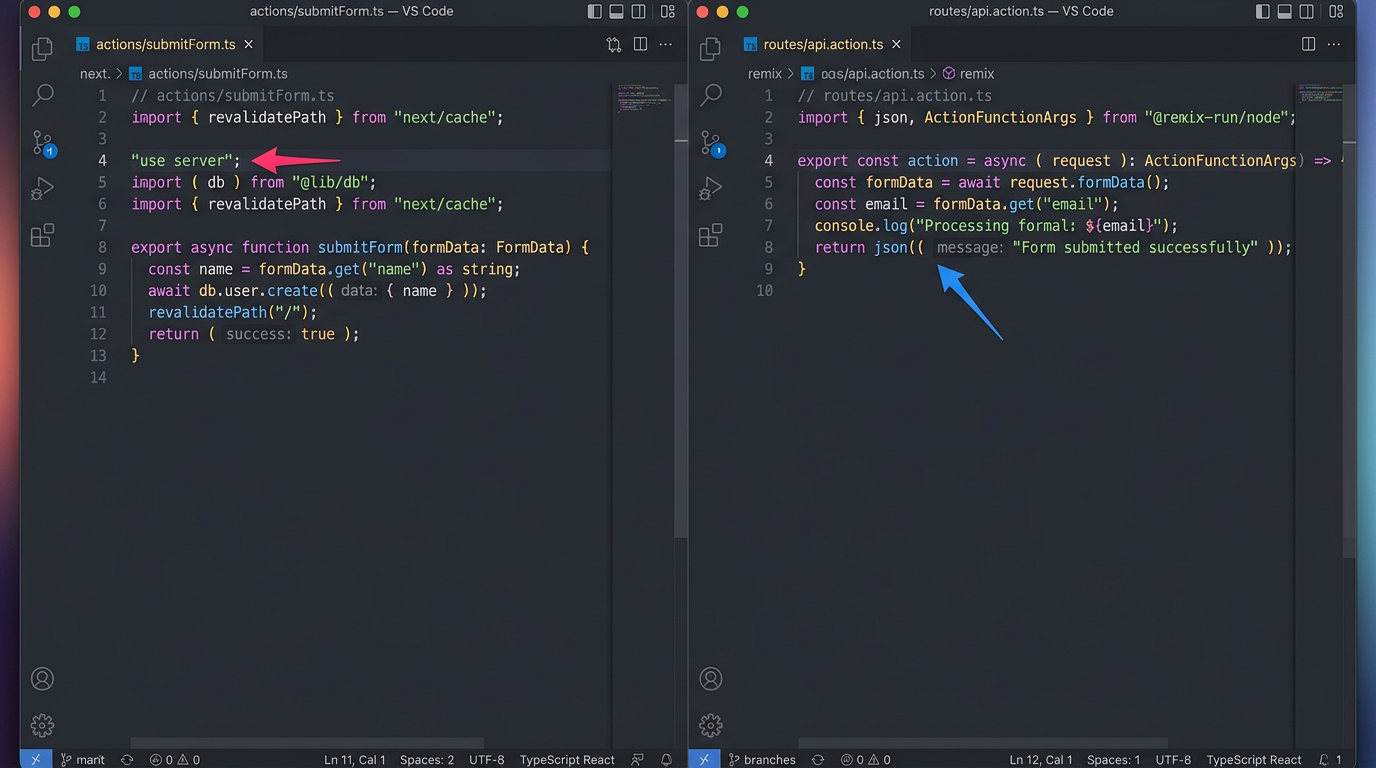
- Simplified Data Flow: The
loaderandactionpattern is, in my experience, the most intuitive way to handle data in React. No moreuseEffectchains for fetching. - Nested Routing: While Next.js has layout nesting, Remix’s approach to error boundaries and loading states at the route level is more robust.
- Resilient UX: By leveraging HTML forms, Remix apps often work (or fail gracefully) even in poor network conditions.
- Deployment Flexibility: Remix feels equally at home on Cloudflare Workers, Fly.io, or a traditional Node server.
The Cons
- Smaller Community: You’ll find fewer ‘plug-and-play’ libraries compared to the Next.js ecosystem.
- Less ‘Magic’ Optimization: You have to be more intentional about your optimization strategies; there’s less automated magic happening behind the scenes.
- Learning the ‘Web Way’: Developers used to SPA patterns may struggle with the shift back to server-centric mutations.
Feature Comparison: Next.js vs Remix 2026
As shown in the comparison table below, the gap is narrowing, but the intent remains different. Next.js optimizes for the delivery of the page, while Remix optimizes for the interaction with the data.
| Feature | Next.js (App Router) | Remix |
|---|---|---|
| Data Fetching | Server Components (async/await) | Route Loaders |
| Data Mutation | Server Actions | Route Actions (HTML Forms) |
| Routing | File-system (Folder-based) | File-system (Flat/Nested) |
| Caching | Aggressive, Multi-layer | HTTP Cache-Control Headers |
| Deployment | Optimized for Vercel | Runtime Agnostic (Edge/Node) |
Real-World Use Cases
I’ve found that the choice usually comes down to the nature of the application:
Choose Next.js if…
You are building a content-heavy site, an e-commerce storefront, or a landing page where SEO and initial load speed are the primary KPIs. If you need to leverage a massive array of third-party React libraries without worrying about compatibility, Next.js is the safer bet.
Choose Remix if…
You are building a complex, data-driven dashboard, an admin panel, or a SaaS application with heavy write-operations. If your app is essentially a series of complex forms and state transitions, the Remix loader/action pattern will save you hundreds of hours of state management headache.
My Verdict
In the battle of next js vs remix 2026, there is no longer a ‘wrong’ answer, only a ‘better fit’.
If I’m starting a project today where I need to move fast and rely on a huge ecosystem, I’m picking Next.js. But for my internal automation tools—where data integrity and a clean mutation flow are more important than milliseconds of LCP—Remix is my default. The mental model of “Web Standards First” simply leads to fewer bugs in the long run.
Ready to start building? I highly recommend experimenting with both in a small prototype. If you’re looking for more ways to optimize your workflow, explore my other articles on productivity tools and development.
Official resources for Next.js vs Remix
Documentation and references for Next.js vs Remix:
