
Introduction: The AI Frontend Dilemma
Over the last year, I’ve spoken with dozens of founders who have incredible machine learning models or clever LLM integrations, but their products are failing to gain traction. The reason? The user interface. When you’re looking for frontend development services for AI startups, you quickly realize that building a traditional web app and building an AI-native web app are two entirely different beasts.
AI applications introduce unique challenges: unpredictable response times, streaming text, complex data visualizations, and the need for fluid state management. If you hire a standard web development agency that doesn’t understand these nuances, you’ll end up with a clunky, frustrating user experience that makes your intelligent backend feel broken.
In this guide, I’ll walk you through exactly what makes AI frontends different, what technical capabilities you need to look for, and how to structure your search for the right development partner.
Fundamentals: Why AI Frontends Are Fundamentally Different
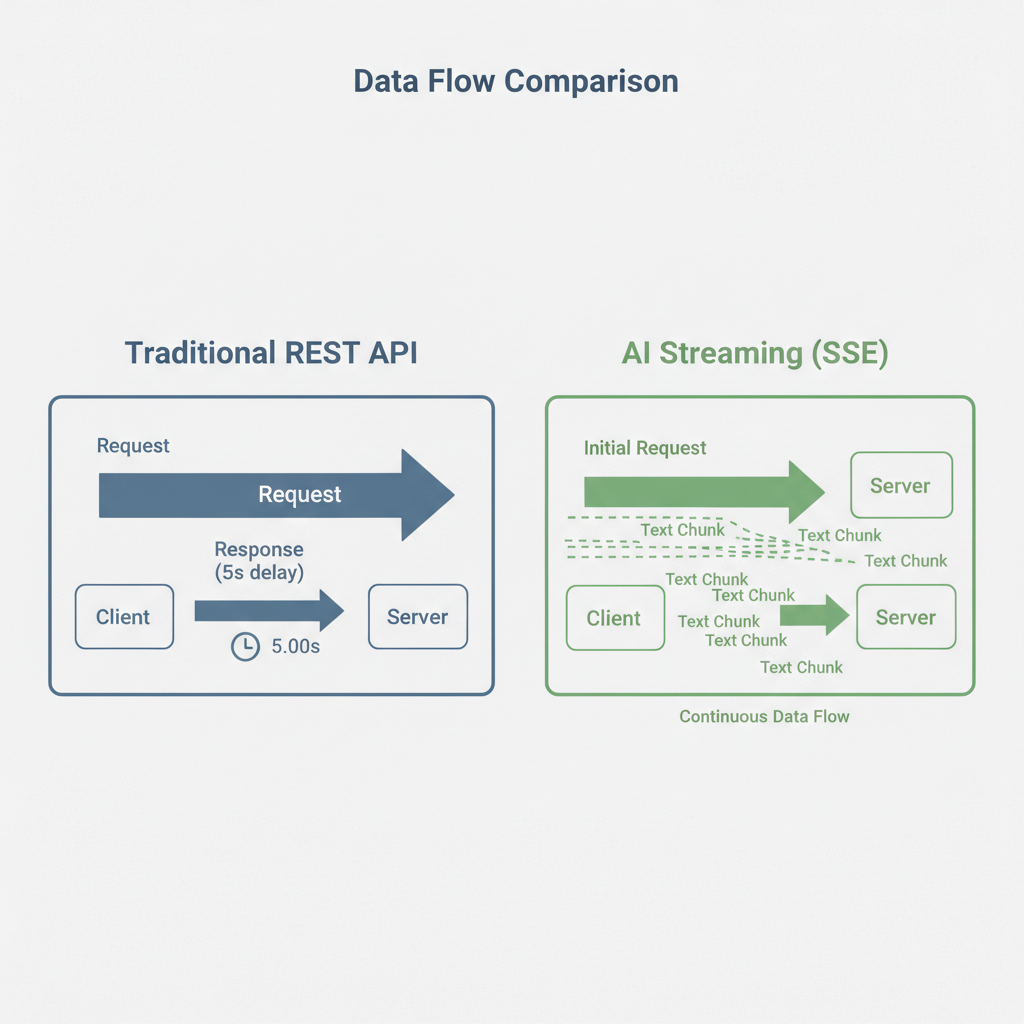
Before you evaluate any frontend development services for AI startups, you need to understand the technical hurdles your product will face. A traditional SaaS app expects a database query to return in under 200 milliseconds. An LLM might take 5 to 10 seconds to fully generate a response.
1. The Latency Problem
Because AI generation takes time, your frontend needs to handle latency gracefully. Staring at a loading spinner for 8 seconds kills user retention. The modern standard is streaming—showing the text to the user token by token as it generates, exactly like ChatGPT does.
2. Complex State Management
AI chats aren’t just text anymore. They are multi-modal. A user might upload a PDF, the AI might return a mix of text, a dynamic chart (often called “Generative UI”), and action buttons. Managing this complex, deeply nested state requires advanced React knowledge.
3. Prompt Injection and Security
While backend security is paramount, the frontend needs to handle client-side validation and ensure API keys are never exposed in the browser bundle. You’d be surprised how many beginner developers leak OpenAI keys in their React code.
Deep Dive: Key Capabilities to Demand from Frontend Development Services for AI Startups
When interviewing an agency or freelancer, you need to look beyond their standard portfolio. Here are the specific technical skills I always test for when vetting teams for my own projects.
Mastery of Server-Sent Events (SSE) and Streaming
Ask your potential developers how they plan to handle streaming responses. If they say “WebSockets,” they might be over-engineering it. If they say “long polling,” run away. The correct answer for standard text streaming is usually Server-Sent Events (SSE) or using a dedicated library.
In my setups, I heavily rely on the Vercel AI SDK. Here’s a quick example of what a modern, clean Next.js API route looks like for streaming OpenAI responses. If your developers write code that looks like this, you’re in good hands:
import { OpenAIStream, StreamingTextResponse } from 'ai';
import OpenAI from 'openai';

const openai = new OpenAI({
  apiKey: process.env.OPENAI_API_KEY,
});

export const runtime = 'edge';

export async function POST(req) {
  const { messages } = await req.json();
  const response = await openai.chat.completions.create({
    model: 'gpt-4-turbo',
    stream: true,
    messages,
  });

  const stream = OpenAIStream(response);
  return new StreamingTextResponse(stream);
}
Generative UI Experience
Text is no longer enough. If a user asks your AI for a financial report, they shouldn’t just get a markdown table. They should get an interactive React component with a D3.js or Recharts graph. This concept (often utilizing React Server Components) is a massive differentiator. Make sure to discuss your startup MVP frontend strategies early so the team knows if Generative UI is a requirement.
Implementation: Evaluating Agency vs. Freelancer vs. In-House
How do you actually hire for this? You have three main paths.
1. The Specialized AI Agency
Pros: They bring a wealth of architectural knowledge. They’ve already solved the streaming, authentication, and vector database connection problems.
Cons: Expensive. You are paying for their polished workflows and overhead.
2. The Senior Freelancer
If you have a strong technical vision but need hands-on-keyboard execution, a senior freelancer is often the sweet spot. When working with freelancers, I recommend following core technical co-founder tips: establish rigid code review processes and enforce CI/CD pipelines from day one.
3. Building In-House
Only recommended if you have deep pockets or a technical co-founder who can lead the team. Integrating a new hire into your AI product development lifecycle takes time that an early-stage startup might not have.
Tools & Tech Stack Guidelines
When you hire frontend development services for AI startups, they should ideally be working within an ecosystem built for this era. If they propose building an AI MVP in pure jQuery or an outdated framework, push back.
- Framework: Next.js (App Router) is currently the gold standard due to its edge computing capabilities and seamless server-side rendering, which is vital for SEO and performance.
- AI Integration: Vercel AI SDK or LangChain.js.
- Styling: Tailwind CSS combined with a component library like shadcn/ui. This allows for rapid iteration without sacrificing design quality.
- State Management: Zustand or Jotai. Redux is often too heavy for lightweight, rapid-iteration AI chat interfaces.
Final Thoughts
Finding the right frontend development services for AI startups isn’t just about hiring coders; it’s about finding product partners who understand how humans interact with artificial intelligence. The gap between a “cool AI wrapper” and a “sticky AI product” is almost entirely bridged by the frontend user experience.
Take your time, ask the right technical questions, and prioritize teams that understand streaming, edge computing, and complex state management.
Frequently Asked Questions
How much do frontend development services for AI startups typically cost?
Costs vary wildly based on scope. A senior freelance developer might charge $80-$150/hour to build an MVP over 4-6 weeks ($15k-$35k). Specialized AI development agencies typically start engagements around $40,000 to $75,000 for a comprehensive, production-ready frontend with complex generative UI features.
Should we hire an agency or freelance developers for an AI MVP?
If you have a technical co-founder to manage architecture and code quality, a specialized freelancer is often more cost-effective. If you lack technical leadership and need a team that brings established AI best practices (like handling Vercel AI SDK and vector DB integrations), an agency reduces risk.
What is the best frontend framework for AI applications?
Currently, Next.js (utilizing the App Router) is the industry standard for AI applications. It pairs perfectly with the Vercel AI SDK, supports Edge computing for faster streaming responses, and allows for React Server Components which are essential for Generative UI.
How do frontend developers handle slow LLM response times?
Instead of making users wait for the entire response to generate, modern AI frontends use Server-Sent Events (SSE) to stream the response token-by-token to the client. This gives the illusion of immediate processing and keeps users engaged.
Do frontend developers need to know machine learning to build AI apps?
No. Frontend developers primarily need to understand how to interact with APIs (like OpenAI, Anthropic, or local endpoints), manage streaming data, handle complex UI state, and implement secure data passing. Deep ML knowledge is usually reserved for the backend or data science team.
What is ‘Generative UI’ in AI frontend development?
Generative UI is a technique where the AI doesn’t just return plain text, but returns structured data that the frontend uses to render dynamic React components. For example, asking for weather returns an interactive forecast widget instead of a text paragraph.
How can we protect our AI API keys on the frontend?
API keys (like OpenAI keys) should never be exposed in the frontend bundle. A competent frontend developer will set up secure API routes or serverless functions that act as intermediaries. The frontend calls your secure backend, which then securely attaches the API key and calls the AI provider.
Official resources for Frontend Development Services for AI Startups
Documentation and references for Frontend Development Services for AI Startups:
