
The Great Persistence Debate: Objects vs. SQL
Choosing a persistence framework is one of the most significant architectural decisions you’ll make in a Spring Boot project. I’ve often been asked by junior devs and architects alike: should I use spring data jpa or mybatis for my next microservice? After a decade of building high-traffic backend systems, I can tell you that the answer isn’t about which tool is “better”—it’s about which one fits your data model and your team’s SQL proficiency.
In this guide, I’ll break down the nuances of both frameworks so you can stop second-guessing and start coding. Whether you’re dealing with a clean-sheet domain model or a legacy database that hasn’t been touched since 2012, one of these tools will clearly emerge as the winner for your specific context.
Option A: Spring Data JPA (The Abstraction Powerhouse)
Spring Data JPA is built on top of Hibernate (the JPA provider). Its primary goal is to minimize boilerplate by allowing you to work with Java objects rather than database rows. In my experience, it is the go-to choice for Rapid Application Development (RAD).
Key Features of Spring Data JPA
- Repository Abstraction: Just define an interface extending
JpaRepository, and Spring generates the implementation for CRUD operations at runtime. - Derived Queries: You can write methods like
findByEmailAndStatus(String email, Status s), and the framework parses the method name into a query. - Object-Relational Mapping (ORM): It handles the complex mapping of object graphs (one-to-many, many-to-many) automatically.
- Caching: First and second-level caching are built-in to reduce DB hits.
The Pros and Cons of JPA
Pros: Excellent productivity, automatic schema generation for prototyping, and seamless integration with the wider Spring ecosystem. If you are following Domain-Driven Design (DDD), JPA’s focus on entities is a natural fit.
Cons: The learning curve for performance tuning is steep. If you aren’t careful, you’ll run into the dreaded N+1 select problem. For a deeper look at this, check out my analysis on spring data jpa vs hibernate performance.
Option B: MyBatis (The SQL-First Alternative)
MyBatis takes a fundamentally different approach. It doesn’t try to hide SQL; it embraces it. Instead of mapping objects to tables, MyBatis maps Java methods to SQL statements (usually defined in XML or annotations).
Key Features of MyBatis
- Full SQL Control: You write the exact SQL that gets executed. No “magic” generated queries that you have to fight to optimize.
- Dynamic SQL: MyBatis excels at building complex queries with conditional logic using its powerful XML tags (like
<if>and<choose>). - Simple Mapping: It provides a straightforward way to map query results to POJOs without the overhead of an entity lifecycle.
- Stored Procedures: If your logic resides in the database, MyBatis handles stored procedure calls much more elegantly than JPA.
The Pros and Cons of MyBatis
Pros: Complete control over performance, easier to debug (the SQL is right there), and it works beautifully with complex legacy databases that don’t follow standard naming conventions.
Cons: High boilerplate. You have to write every SQL statement yourself—even basic inserts. There is no automatic schema generation, and refactoring column names requires manual updates in XML files.
Direct Comparison: Feature Table
Here is how the two stack up across the metrics that actually matter in production environments.
| Feature | Spring Data JPA | MyBatis |
|---|---|---|
| Development Speed | Very High (Automatic CRUD) | Moderate (Manual SQL) |
| Query Control | Abstracted (JPQL/Criteria) | Total (Native SQL) |
| Learning Curve | Steep (Persistence Context/Proxies) | Low (If you know SQL) |
| Performance Tuning | Complex (Fetching strategies) | Simple (SQL optimization) |
| Legacy DB Support | Difficult to map | Excellent |
Pricing and Maintenance Costs
While both frameworks are open-source (Apache 2.0 and MIT respectively), the “cost” comes in maintenance and developer hours. In my time as a consultant, I’ve seen teams spend thousands of dollars in developer time trying to fix JPA performance issues that wouldn’t have existed in MyBatis. Conversely, I’ve seen MyBatis projects become unmaintainable spaghetti code because every simple change required updating dozens of XML files.
When considering scalability, don’t forget your infrastructure. For high-read applications, you might need a spring boot redis caching strategy to mitigate the load, regardless of which framework you choose.
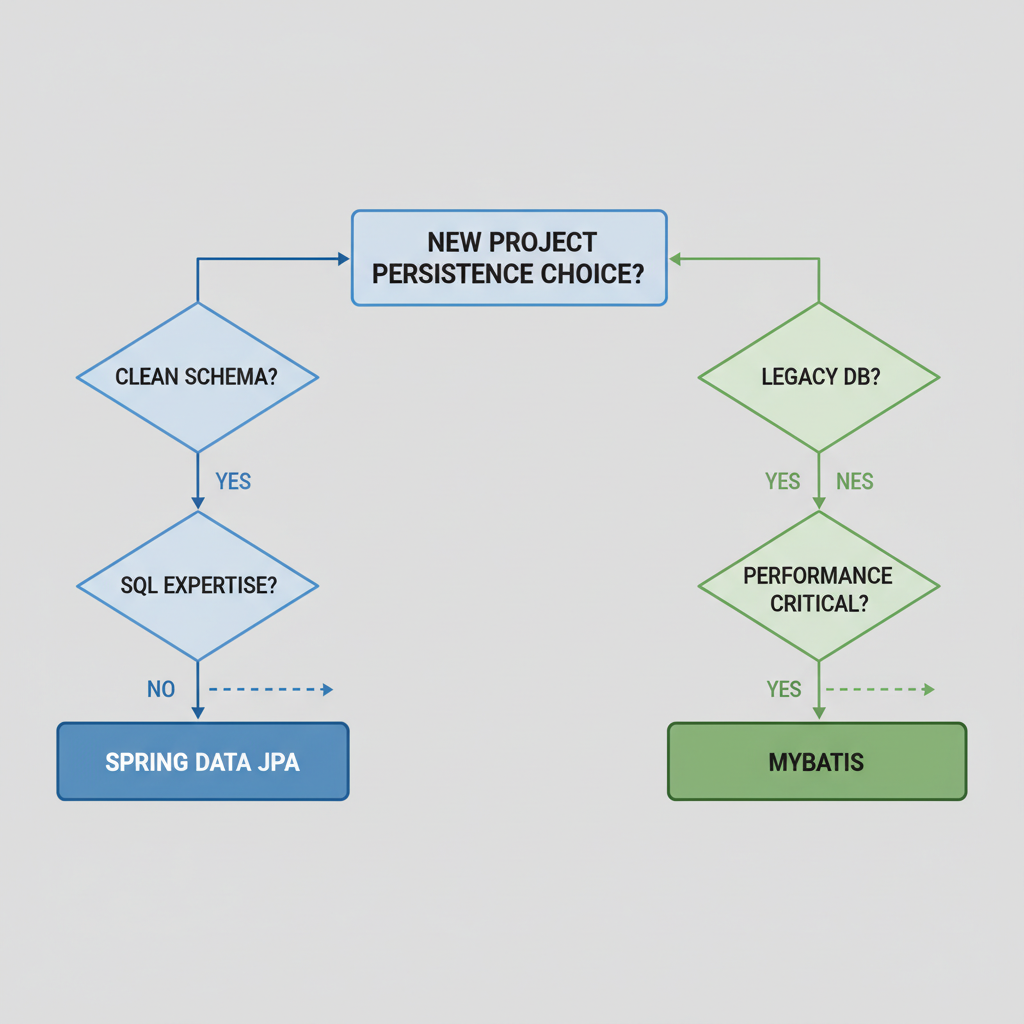
Decision Tree: Who Should Use What?
Still wondering “should i use spring data jpa or mybatis?” Here are the specific scenarios where I recommend one over the other.
Use Spring Data JPA if:
- You are building a new application with a clean, standard database schema.
- You want to focus on business logic rather than writing basic SQL.
- Your team is comfortable with the JPA entity lifecycle and Hibernate’s nuances.
- You need to easily switch between different database types (H2 for testing, PostgreSQL for prod).
Use MyBatis if:
- You are integrating with a legacy database with non-standard structures or heavy use of stored procedures.
- Your application requires highly optimized, complex queries with multiple joins and subqueries.
- You have a dedicated DBA team that provides pre-optimized SQL.
- You prefer the transparency of seeing exactly what is hitting your database.
My Verdict
In most modern microservice environments where the database is “private” to the service and the schema is simple, Spring Data JPA is my winner. It allows you to move incredibly fast. However, for reporting services or data-intensive applications where every millisecond of query time counts, I always lean toward MyBatis.
If you’re starting a new project today, I recommend starting with JPA. If you find yourself writing @Query(nativeQuery = true) for 80% of your methods, that’s a clear signal you should have used MyBatis.