
The Persistence Paradox: Should I Use Spring Data JPA or MyBatis?
Choosing a persistence framework is one of the most consequential decisions you’ll make when starting a new Spring Boot project. In my experience building high-traffic microservices, I’ve seen teams paralyzed by this specific question: should I use spring data jpa or mybatis? It’s not just a matter of syntax; it’s a choice between two fundamentally different philosophies of data access.
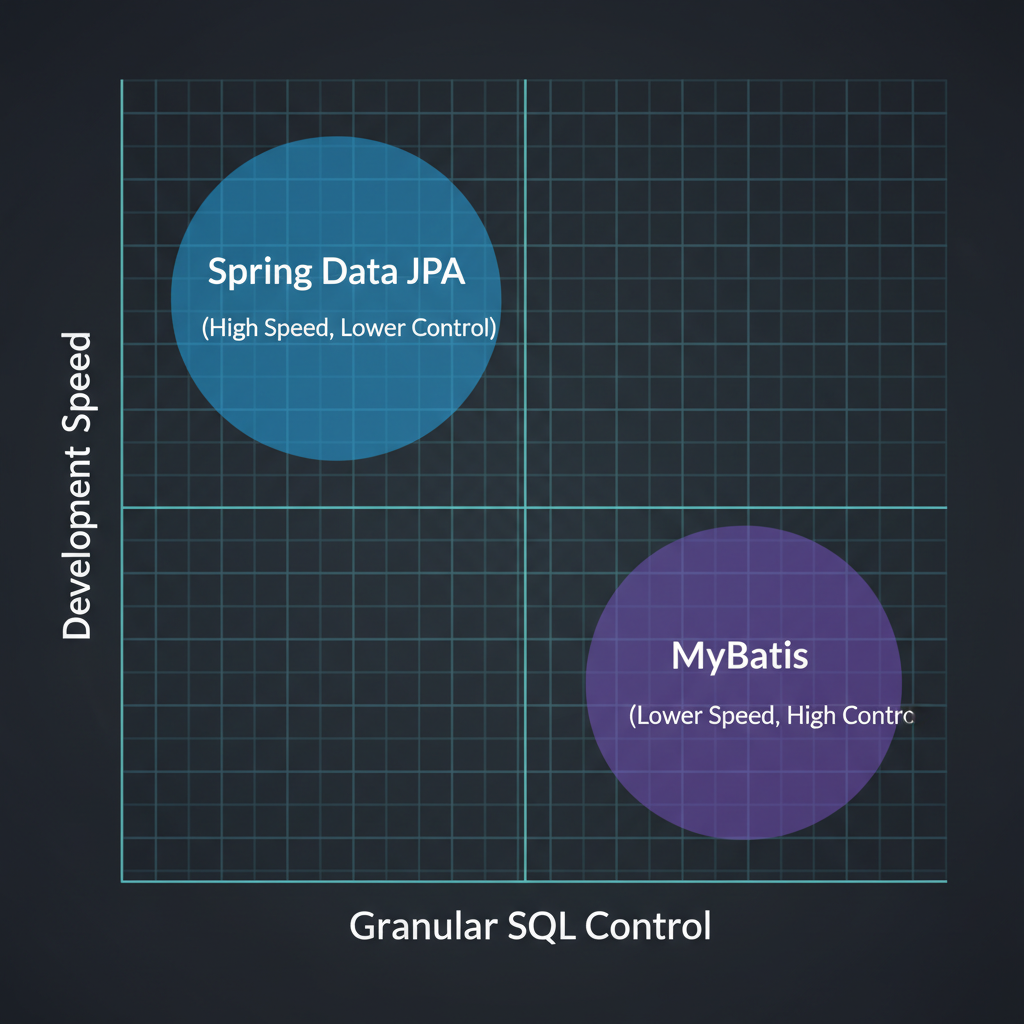
Spring Data JPA is built on top of Hibernate and focuses on an Object-Relational Mapping (ORM) approach, where your database is treated as a collection of Java objects. MyBatis, on the other hand, is a “SQL Mapper” that gives you full control over the raw SQL while automating the tedious JDBC boilerplate. In this guide, I’ll break down the trade-offs so you can make an informed decision for your specific use case.
Option A: Spring Data JPA (The Productivity King)
Spring Data JPA is the default choice for most modern Spring Boot applications. It leverages the power of Hibernate to provide a high-level abstraction over your database. Instead of writing queries, you define interfaces and entities.
Core Features
- Repository Abstraction: Just extend
JpaRepository, and you get CRUD operations for free. - Query Methods: Write methods like
findByEmailAddressAndLastname, and Spring generates the SQL for you. - Dirty Checking: Hibernate automatically detects changes to objects and flushes them to the database.
- Caching: Built-in first and second-level caching (often paired with a spring boot redis caching strategy for distributed setups).
Pros of Spring Data JPA
- Rapid Development: You can stand up a full REST API with persistence in minutes.
- Standardization: It follows the JPA (Jakarta Persistence) specification, making it a highly transferable skill.
- Schema Generation: Can automatically generate or update your database schema based on your entities (though I recommend Flyway for production).
Cons of Spring Data JPA
- The “N+1” Problem: It’s very easy to accidentally write code that performs hundreds of unnecessary queries.
- Performance Overhead: Hibernate’s abstraction layer adds CPU and memory overhead compared to raw SQL. You should check out my deep dive on spring data jpa vs hibernate performance to understand these costs.
- Complex Queries are Painful: Writing high-performance reports or complex JOINs often requires falling back to Native Queries or Specification APIs, which can feel clunky.
Option B: MyBatis (The SQL Surgeon)
MyBatis takes the opposite approach. It assumes that you know SQL better than an abstraction layer ever could. It allows you to write your SQL in XML files or annotations and maps the results directly to your POJOs.
Core Features
- SQL Separation: Keep your SQL separate from your Java logic, making it easier for DBAs to review.
- Dynamic SQL: Powerful tags like
<if>,<choose>, and<foreach>make building complex, conditional queries straightforward. - Direct Mapping: Precise control over how database columns map to Java fields.
Pros of MyBatis
- Maximum Performance: Since you write the SQL, you can use database-specific hints, window functions, and optimizations that ORMs struggle with.
- Lower Learning Curve (SQL): If you are already a SQL expert, you don’t need to learn a complex ORM API or JPQL.
- Legacy Friendly: Perfect for working with existing databases that don’t follow standard ORM naming conventions or use complex stored procedures.
Cons of MyBatis
- Boilerplate: You have to write every SQL statement manually, even simple
INSERTorDELETEoperations. - Fragility: If you rename a database column, you must manually find and update every XML mapper referencing it.
- Vendor Lock-in: If you use database-specific SQL features, switching from PostgreSQL to MySQL becomes a major project.
The Comparison Table
| Feature | Spring Data JPA | MyBatis |
|---|---|---|
| Approach | Object-Relational Mapping (ORM) | SQL Mapping |
| Developer Speed | High (for CRUD) | Medium |
| SQL Control | Limited (Abstraction) | Absolute (Full Control) |
| Performance | Good (but requires tuning) | Excellent (Optimal) |
| Complexity | High (Magic can be confusing) | Low (Transparent) |
Use Cases: When to Choose What?
In my experience, the decision on should i use spring data jpa or mybatis usually boils down to the nature of the project. I’ve found that for standard microservices where the domain model is primary, JPA wins. However, for data-heavy reporting engines, MyBatis is the clear victor.
Use Spring Data JPA If:
- You are building a greenfield project with a clean domain model.
- You need to move fast and prioritize developer productivity.
- Your application primarily performs CRUD operations.
- You want to leverage ecosystem tools like QueryDSL or Spring Data REST.
Use MyBatis If:
- You are integrating with a legacy database with a “messy” schema.
- Your application requires highly optimized, complex SQL queries.
- You have a dedicated DBA team that wants to review and tune every SQL statement.
- You prefer to write SQL rather than learning the intricacies of Hibernate’s persistent context.
My Verdict
After a decade of backend engineering, my recommendation is this: Start with Spring Data JPA. The productivity gains for 80% of your application’s logic are too significant to ignore. For the remaining 20%—those nasty reporting queries or performance bottlenecks—don’t be afraid to use a hybrid approach. You can actually use MyBatis or JdbcClient alongside JPA in the same Spring Boot application to get the best of both worlds.
Regardless of your choice, remember that your database performance often depends more on indexing and query structure than the framework itself. If you’re seeing slow response times, I recommend checking out our guide on optimizing SQL queries to ensure your bottleneck isn’t the framework, but the data access patterns themselves.