When I first started building with SvelteKit, the speed was intoxicating. But as soon as my projects grew beyond a few static pages, I hit a wall: content management. Hardcoding JSON files into the src/lib folder isn’t scalable, and traditional WordPress setups feel like bringing a horse and buggy to a Formula 1 race.
Finding the best headless CMS for SvelteKit isn’t just about which one has the most features; it’s about which one respects the SvelteKit lifecycle. You want a CMS that plays well with load functions, supports ISR (Incremental Static Regeneration) or fast SSR, and doesn’t bloat your bundle. In my experience, the ‘best’ choice depends entirely on whether you value absolute control, rapid deployment, or a polished editor experience.
Option 1: Sanity.io (The Developer’s Favorite)
Sanity is often the first recommendation for SvelteKit developers, and for good reason. Unlike traditional CMSs, Sanity treats content as data (Content Lake) rather than pages. This aligns perfectly with how SvelteKit handles data fetching in +page.server.ts.
The Pros
- Real-time Collaboration: The Sanity Studio is highly customizable and allows multiple editors to work simultaneously without overwriting each other.
- GROQ & GraphQL: I personally prefer GROQ for its power in shaping the data before it even hits my Svelte components.
- Excellent Svelte Integration: Their client libraries are lightweight and easy to implement.
The Cons
- Learning Curve: GROQ is a new language to learn if you’re used to standard REST or GraphQL.
- Pricing Jump: While the free tier is generous, the jump to professional plans can be steep for small projects.
Option 2: Contentful (The Enterprise Powerhouse)
If you are building a site for a corporate client who needs strict governance and a polished UI, Contentful is hard to beat. It’s an industry standard for a reason, providing a rock-solid API that rarely flickers.
The Pros
- Stability: I’ve never experienced a significant outage during a production launch with Contentful.
- CDN Performance: Their global CDN is incredibly fast, which helps keep your SvelteKit
loadfunctions snappy. - Rich Tooling: The content modeling UI is intuitive for non-technical users.
The Cons
- Rigidity: The content modeling can feel a bit restrictive compared to the fluidity of Sanity.
- Cost: It is arguably the most expensive option on this list once you move past the community tier.
Option 3: Strapi (The Self-Hosted King)
For those of us who hate the idea of “vendor lock-in,” Strapi is the answer. Since it’s open-source and self-hosted, you own your data and your infrastructure. This is particularly useful when deploying SvelteKit to Cloudflare Pages and wanting a backend that lives in your own VPC.
The Pros
- Full Control: You can customize the backend logic using Node.js.
- Open Source: No monthly subscription fees if you host it yourself.
- REST & GraphQL: Out-of-the-box support for both major API styles.
The Cons
- Maintenance Overhead: You are responsible for backups, security patches, and server uptime.
- Deployment Complexity: Setting up a production-ready Strapi instance is significantly more work than clicking “Create Project” in Sanity.
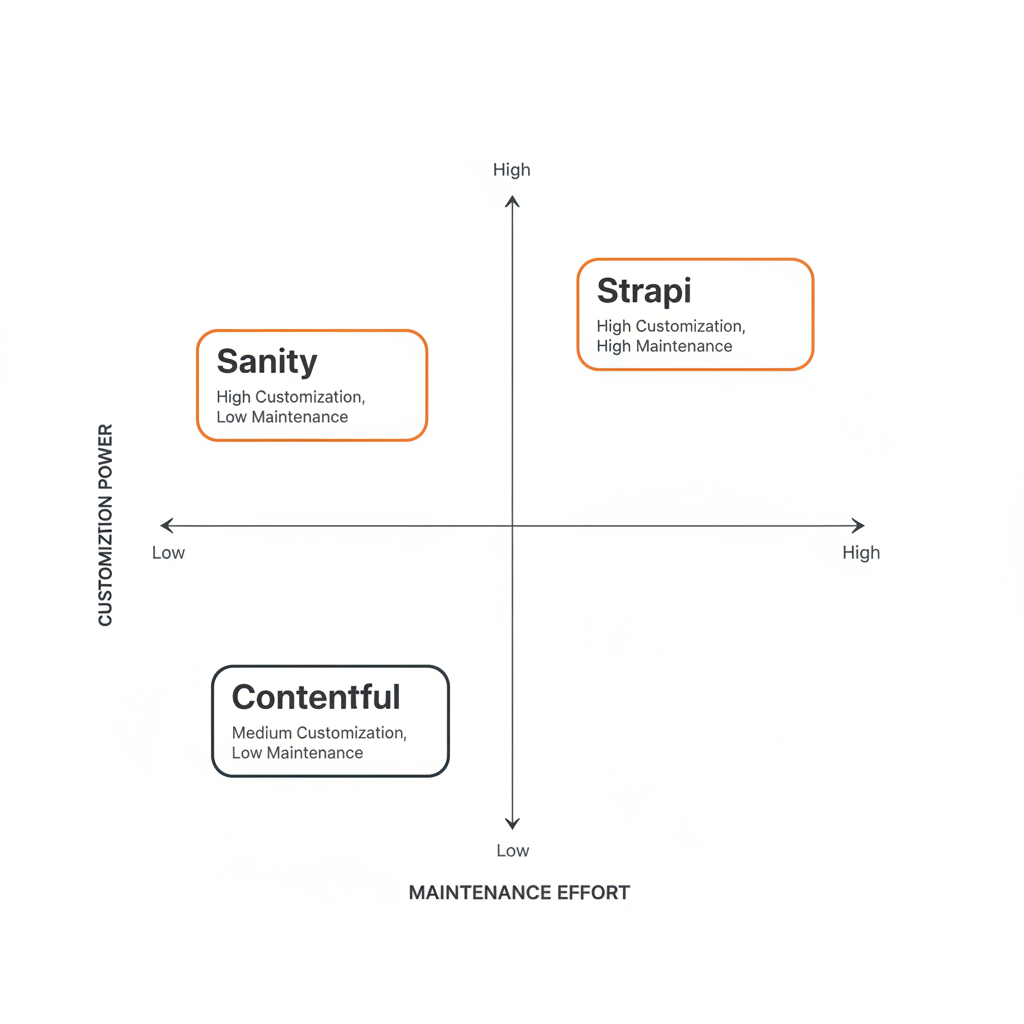
As shown in the comparison visual below, the trade-off usually comes down to Maintenance vs. Cost. If you have the DevOps skills, Strapi is a dream; if you want to focus purely on the frontend, Sanity or Contentful are the way to go.
Feature Comparison Table
| Feature | Sanity | Contentful | Strapi |
|---|---|---|---|
| Hosting | Managed | Managed | Self-Hosted / Cloud |
| Query Language | GROQ / GraphQL | REST / GraphQL | REST / GraphQL |
| Customizability | Very High | Medium | Infinite (Code-based) |
| Onboarding Speed | Fast | Very Fast | Medium |
Which one should you choose?
In my experience, the decision boils down to your project’s scale and your personal tolerance for server management. If you’re wondering if SvelteKit is even the right framework for your needs, you might want to check out my breakdown of SvelteKit vs SolidJS for performance to ensure your frontend choice matches your CMS capabilities.
Use Case: The Personal Blog or Portfolio
Go with Sanity. The ability to customize the Studio allows you to build a tailored writing experience, and the free tier is more than enough for a personal site.
Use Case: The Enterprise Corporate Site
Choose Contentful. The reliability and the polished editor UI will save you hours of support calls from your marketing team.
Use Case: The Data-Sensitive Application
Strapi is the winner. When you need to ensure your data never leaves your own servers for compliance reasons, self-hosting is the only viable path.
Best Headless CMS for SvelteKit: My Final Verdict
If I have to pick the best headless CMS for SvelteKit for 90% of developers, it’s Sanity.io. The synergy between Svelte’s reactivity and Sanity’s real-time content lake feels natural. It removes the friction between the database and the UI, allowing you to iterate at the speed of thought.
server-side load functions to fetch your data. This prevents your API keys from leaking to the client and ensures your pages are SEO-friendly from the first byte.
Official resources for Best Headless CMS for SvelteKit
Documentation and references for Best Headless CMS for SvelteKit:
