Introduction: The Persistence Paradox
When starting a new Spring Boot project, one of the first questions that hits the whiteboard is: should I use Spring Data JPA or MyBatis? In my experience building high-scale backends, the answer isn’t a simple ‘this one is better.’ It depends entirely on whether you value developer productivity and abstraction over granular control and SQL optimization.
Spring Data JPA is the ‘magic’ choice that handles most of the heavy lifting for you, while MyBatis is the ‘mechanic’s’ choice, giving you direct access to the engine. In this guide, I’ll break down the nuances of each so you can make an informed choice for your specific architecture.
Option A: Spring Data JPA (The ORM Powerhouse)
Spring Data JPA is a layer on top of a JPA provider (typically Hibernate). It allows you to interact with your database using Java objects rather than SQL strings.
Core Features
- Repository Abstraction: Write an interface, and Spring generates the implementation at runtime.
- Query Methods: Create queries just by naming methods, like
findByLastNameAndAge. - Automatic Schema Generation: Perfect for rapid prototyping and greenfield projects.
- Auditing: Built-in support for
@CreatedDateand@LastModifiedBy.
Pros
- Extremely high developer productivity for standard CRUD operations.
- Reduces boilerplate code by up to 80% compared to traditional JDBC.
- Type-safe queries via Criteria API or Querydsl.
- Seamless integration with the Spring ecosystem.
Cons
- Significant ‘magic’ can make debugging complex join issues difficult.
- Performance overhead due to the abstraction layer and object-relational mapping. You can read more about this in my analysis of spring data jpa vs hibernate performance.
- Steep learning curve to master things like N+1 query problems and lazy loading.
Option B: MyBatis (The SQL First Approach)
MyBatis is not a full ORM; it’s a data mapper. It allows you to map your Java objects to results from raw SQL queries stored in XML or annotations.
Core Features
- Direct SQL Control: You write the exact SQL that gets executed.
- Dynamic SQL: Powerful XML tags for building complex, conditional queries.
- Result Mapping: Explicitly map database columns to Java properties.
Pros
- Total control over performance. If a query is slow, you fix the SQL directly.
- Better for legacy databases with complex schemas that don’t map cleanly to objects.
- Easier for DBAs to review and optimize queries without knowing Java.
- No ‘magic’ proxies—what you see in the XML is what happens in the DB.
Cons
- High amount of boilerplate; you must write SQL for even basic CRUD.
- Less ‘integrated’ feeling in a standard Spring Boot setup compared to JPA.
- Refactoring Java class names requires manual updates to XML mappers.
Feature Comparison Table
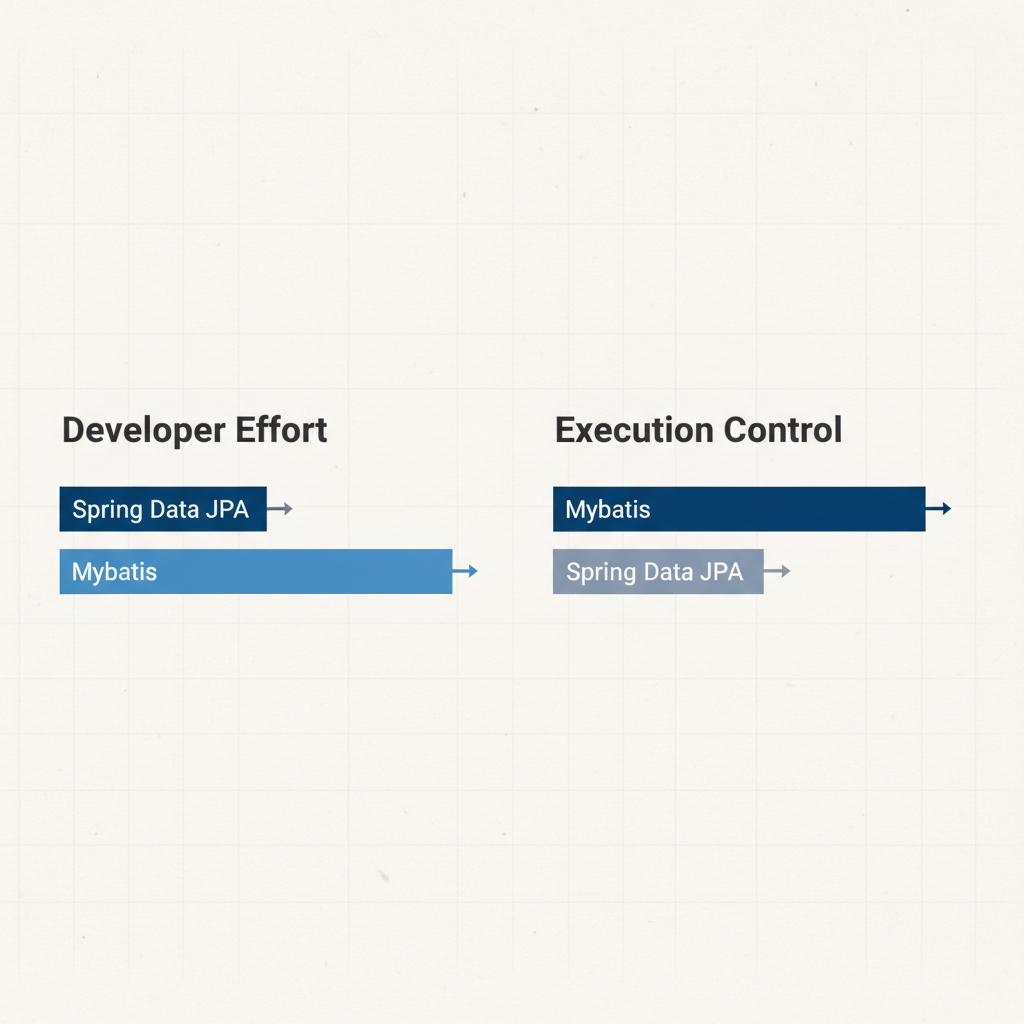
| Feature | Spring Data JPA | MyBatis |
|---|---|---|
| SQL Writing | Optional (Generated) | Required (Manual) |
| Productivity | Very High | Moderate |
| Learning Curve | High (to master) | Low (if you know SQL) |
| Performance | Potential Overhead | Optimized |
| Legacy DB Support | Challenging | Excellent |
Pricing and Licensing
Both frameworks are open-source and free to use in commercial projects. Spring Data JPA (under the Spring Umbrella) and MyBatis are both licensed under the Apache License 2.0. The ‘cost’ isn’t in licenses, but in maintenance and developer hours. In my experience, a team unfamiliar with JPA might spend more hours debugging Hibernate sessions than it would have taken to just write the SQL in MyBatis.
Use Cases: Which One Fits You?
When to Choose Spring Data JPA
I recommend JPA for greenfield projects where you own the database schema. If your application is primarily CRUD-based and you need to move fast, the standard backend architecture heavily favors Spring Data JPA. It also shines when you need to implement complex spring boot redis caching strategies because the abstraction layer makes it easier to intercept calls.
When to Choose MyBatis
MyBatis is my go-to for optimizing database queries in Java for high-throughput systems. If you are working with a legacy database, stored procedures, or extremely complex joins that involve proprietary SQL hints, MyBatis is much less frustrating. It’s also a great fit for teams where SQL is a primary skill set over Java-specific ORM knowledge.
Should I Use Spring Data JPA or MyBatis: My Verdict
After a decade of building Spring applications, here is my final take: Use Spring Data JPA by default for 90% of modern web applications. The speed at which you can deliver features is too high to ignore. However, for the 10% of projects that require pixel-perfect SQL performance or deal with ‘messy’ databases, don’t be afraid to reach for MyBatis. You can even use both in the same project, leveraging JPA for simple entities and MyBatis for complex reporting queries. For more advanced tips, check out my microservices development guide.
More on this topic: IDEs, Git clients and database GUIs, every comparison and guide in one place.
Official resources for Should I Use Spring Data JPA or MyBatis
Documentation and references for Should I Use Spring Data JPA or MyBatis:
