
The State of the Frontend in 2026
If you’ve been following the ecosystem, you know that the ‘framework wars’ have shifted. We are no longer just arguing about virtual DOM vs. signals; we are arguing about where the code actually runs. When looking for the top frontend frameworks for 2026, the conversation is dominated by Server Components, partial hydration, and the push toward zero-bundle-size clients.
In my experience building automation tools and dashboards over the last two years, I’ve found that the ‘best’ framework is rarely the fastest one on a benchmark—it’s the one that lets you ship a feature without fighting the build tool for three days. Whether you’re building a high-traffic e-commerce site or a niche productivity tool, your choice of stack will dictate your velocity for the next 24 months.
The Fundamentals: What Matters Now?
Before we dive into the specific frameworks, we need to establish the criteria I used for this 2026 guide. In the current landscape, three factors outweigh everything else:
- Hydration Strategy: Does the framework send a massive JS bundle to the client, or does it use ‘islands’ or ‘resumability’ to keep the page light?
- Type Safety: In 2026, TypeScript isn’t optional. I only consider frameworks that provide first-class TS support.
- The Edge Runtime: With the rise of Vercel, Netlify, and Cloudflare Workers, the ability to run logic at the edge is a non-negotiable requirement for performance.
Deep Dive: The Heavy Hitters of 2026
1. Next.js (The Industry Standard)
Next.js continues to be the dominant force. With the full maturation of App Router and Server Components, it has effectively become a full-stack framework. I use Next.js when I need a massive ecosystem and a guaranteed hiring pool.
The biggest strength here is the seamless transition between server and client components. However, the complexity of the caching model can still be a headache. If you’re undecided on your meta-framework, you might want to check out my detailed breakdown of Next.js vs Remix 2026 to see which architectural approach fits your mental model better.
2. SvelteKit (The DX Champion)
SvelteKit feels like it was designed by people who actually enjoy writing HTML. By moving the work to a compile-step, it removes the overhead of a virtual DOM. In my recent productivity tool project, switching to SvelteKit reduced my bundle size by nearly 40%.
If you are obsessed with raw speed and a clean syntax, you’ll find the comparison of SvelteKit vs SolidJS for performance particularly enlightening, as both challenge the React hegemony from different angles.
3. SolidJS (The Performance King)
SolidJS gives you the JSX you love from React but with a reactivity system based on signals. It doesn’t re-render components; it only updates the specific part of the DOM that changed. This makes it the go-to for highly interactive dashboards where every millisecond counts.
4. Vue.js / Nuxt (The Versatile Middle Ground)
Nuxt remains an incredible choice for developers who want a more structured, opinionated framework than Next.js but more flexibility than Svelte. Its module system is still, in my opinion, the best in the industry for rapidly adding features like Auth or CMS integration.
Implementation: How to Choose Your Stack
Choosing among the top frontend frameworks for 2026 shouldn’t be a guessing game. I use a simple decision matrix based on the project goals:
| Project Type | Recommended Stack | Why? |
|---|---|---|
| Enterprise SaaS | Next.js | Ecosystem, Talent Pool, Vercel Integration |
| High-Perf Dashboard | SolidJS | Fine-grained reactivity, minimal overhead |
| Content-Heavy Site | SvelteKit | Excellent SEO, fast load times, simple DX |
| Rapid Prototype | Nuxt | Powerful module system, intuitive structure |
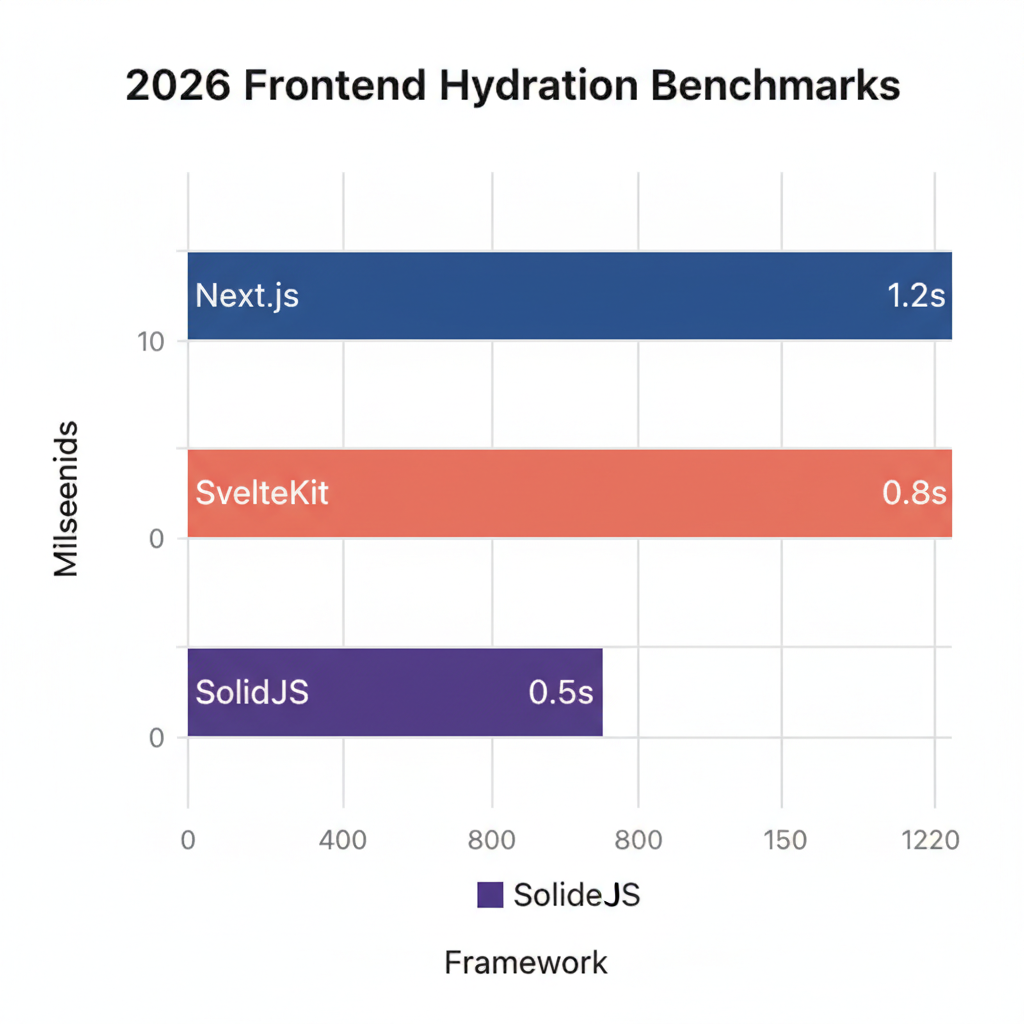
As shown in the performance chart below, the gap between these frameworks is narrowing, but the architectural differences remain stark.
Principles for Long-Term Maintainability
Regardless of the framework you choose, I’ve found that these three principles prevent ‘rewrite fatigue’ every two years:
- Decouple Business Logic: Keep your API calls and state transformations in pure TypeScript functions, not inside framework-specific hooks.
- Prioritize Standard Web APIs: Use
URLSearchParams,localStorage, andRequest/Responseobjects instead of framework wrappers where possible. - Avoid ‘Magic’ Libraries: Be wary of libraries that promise to solve everything but introduce proprietary syntax that will be deprecated by 2027.
Essential Tools for the 2026 Frontend Dev
Your framework is only as good as your tooling. For any of the top frontend frameworks for 2026, I recommend this baseline setup:
- Runtime: Bun (for lightning-fast installs and test running).
- Styling: Tailwind CSS (still the king of utility-first CSS).
- State Management: Zustand or TanStack Query (keep it simple, avoid Redux unless mandated by legacy).
- Deployment: Vercel or Railway for automated CI/CD pipelines.
If you’re looking to automate your deployment workflow, I highly recommend exploring my other guides on automation tools to shave hours off your weekly sprint.